The Tutor’s Thinking

It probably comes as no surprise that our tutors love to read and write. But have you ever wondered our tutor’s favorite genre’s of writing are?

  • Pierce declared that his favorite genre of writing is fantasy, of course!
  • Mandi said that she has two favorite genres of writing, and they are creative writing and fiction.
  • Rhia stated that her favorite genre of writing is fiction, in any sort
  • Ari replied that they love romance, stating that they will take it all. They like to see characters fall in love even if it is a bit awkward at first.
  • Sidney stated that her favorite genre is historical fiction, which makes a lot of sense for a History Education major!
  • Cam responded saying that they enjoy both fiction and fantasy. They have a lot to talk about with both Pierce and Rhia!
  • Lauren replied with the most genres out of anybody, saying that Romance, Fiction, and mystery/thrillers all all her favorites!

So those are some of our tutor’s favorite genre’s of writing, what are your favorite genres of writing?

The Tutors’ Thinking

Are movies EVER better than the books? Let’s see what our tutors think…

33% of our tutors who responded say…YES!

33% of our tutors say…sometimes?

And only 33% of our tutors say…NO!

Let’s hear their arguments…

  • Pierce was one of our sometimes people; it all depends on whether you read the book first (which makes the movie worse) or if you watch the movie first (which makes the book worse).
  • Mandi is one of our NO believers…she gave credit to some being better but most of the time, they’re not.
  • Rhia says YES, and she even acknowledged that English majors keep that a secret from you all!
  • Ari says it all depends…especially when the original book has the right idea with ZERO execution.
  • Cam says MOST of the time they’re not…but they make some exceptions…what are those exceptions, Cam?
  • Finally, Lauren confidently says yes, and she believes the people who say no are lying to themselves.

Our tutors are torn, but do you believe movies are better than the books? Which ones are?

~ Lauren

The Tutors’ Thinking

If our Writing Center tutors could be any book character…who would they be?

Pierce says he would probably be Winnie the Pooh. It’s unclear whether he said this because Pooh gets to live a life as a snuggly, laid-back bear, or if it’s because Pierce is just so lovable, too.

Mandi says she would be Belle from Beauty and the Beast. She would look beautiful in Belle’s big yellow dress! Mandi is also a bookworm who’s sweet and caring, just like Belle, so she’s basically Belle already.

Rhia, one of our student managers, would be Belly Conklin from The Summer I Turned Pretty. Belly is a very romantic dreamer. This may be Rhia, or maybe she’s just so enthralled by the Fisher brothers’ love triangle! A page turner, for sure.

Ari says they would be Olive Smith from The Love Hypothesis because they’re just such a hopeless romantic!

Cam says they would be Winnie the Pooh or Christopher Robin, but since Pierce already claimed Winnie, Cam could be his human companion in the story of Winnie the Pooh! Besties!

Finally, Lauren says she would be Katniss Everdeen (a.k.a me). I would be Katniss because of my fierce bravery…except I’m not fiercely brave, I just wish I could be as awesome as Katniss is.

If you could be any book character, who would you be? Why?

~ Lauren


Becoming a More Confident Writer

Doubting your ideas, capabilities, and strengths is very normal, whether you’re a professional or academic writer. However, where this becomes a problem is when it hinders your motivation and ability to complete your work. I would like to share some insights about tips and tricks that work for me to push past the barriers that I often create for myself 🙂

  1. View the feedback you get, whether from peers or professors, as a chance to grow not as a failure – as someone who tutors, when I give anyone who comes into the Writing Center feedback about the strengths or growth areas of their work, my feedback ALWAYS comes from a place of, “I want to help this person in any way I can,” not a place of, “I want to criticize their work.” It’s so easy to think that feedback or criticism undermines the work you thought was good, but writing is objective sometimes, so people see things differently than you. Take feedback with a grain of salt, and try your best to see it as an opportunity to get better, not an opportunity to tear yourself down.
  2. Embrace that your ideas are unique to you – embrace your creativity and experiences. Don’t undermine the interest of your topic either, especially if it’s personal. I know that as someone who is going to be a future teacher, I can’t wait to see what all of my students will bring to the table when they write. And as an academic writer myself, I find it really easy to feel like my ideas are silly or not interesting enough. But if I feel confident with it, I am not going to worry about judgment, especially from peers, because it matters to ME.
  3. Focus on your strengths as a writer, and use that as a tool to succeed – if your strength is grammar, voice, structure, prewriting, revising, researching, brainstorming, etc., then CAPITALIZE on them while you’re writing. View every writing opportunity as a way to show off what you are great at doing. And along the way, when you come across criticism or necessary areas of growth, then know that that just means you can now grow in those areas too and be a master of that domain too!

My biggest takeaway, I hope you all get from this, is that your trust in your own abilities matters more than anything. If you ever feel doubtful, come on over to the Writing Center for some positive and constructive feedback on any writing you worked on!

~ Lauren

Spring Break 2026

Hi writers!

We’re gearing up to head into Spring Break. Sadly, the Writing Center is not open over Spring Break, but come see us before we close for break to get all those midterm papers checked on!

Our hours for the remainder of the week are:

  • Thursday: 12-8pm
  • Friday: 12-4pm

The Writing Center wishes you a relaxing Spring Break 🙂

~ Lauren

Writing a Research Paper – Turning Your Outline into a Paper!

Hi everyone!

Now that you have gathered your sources, written your outline, and formatted your in text citations, it’s time to finally draft your paper! This may feel like one of the most daunting steps in the writing process, but with all of the prep work that we’ve done beforehand, it should go smoothly! Before we get right into drafting the paper, let’s discuss what some of the elements we have gathered thus far will become:

Gathering Research:

Your research should have been one of the biggest factors in creating your outline. This research will be used to prove that there is evidence to support whatever claim you are making in your topic sentence.

Choosing a topic:

Your topic is the entire backbone of your paper. This topic will be the main organizing principle in  your paper which will be used to guide the focus of your paper. This topic will also be the backbone of your thesis statement.

Creating a Thesis Statement:

Your thesis statement should house the point that you are trying to prove in your paper. This will be housed in your introduction paragraph, and referenced throughout your paper with every point that you make. Your outline will then contain all of the pieces of evidence you will use to prove the point made in your thesis.

Creating an outline:

Your outline will contain all of the points of evidence you are going to use to to prove your thesis statement. This will contain the bulk of the content of your paper.

So how does all of this come together to create a research paper draft?

First, you will want to write your introduction paragraph. This should start off with a hook. Your hook should be a bit more broad than your topic and be used to grab your reader’s attention. Think about your audience when drafting out an appropriate hook. Then, you will want to introduce your topic. This is where you want to work towards introducing your topic to your reader. Don’t get super specific to your argument here, as this going into the third step. The third step is writing your thesis statement. This is where you get very specific to your paper and state the argument that you are going to spend the rest of the paper proving. See this image if you need this explained a little bit more of a visual manner:
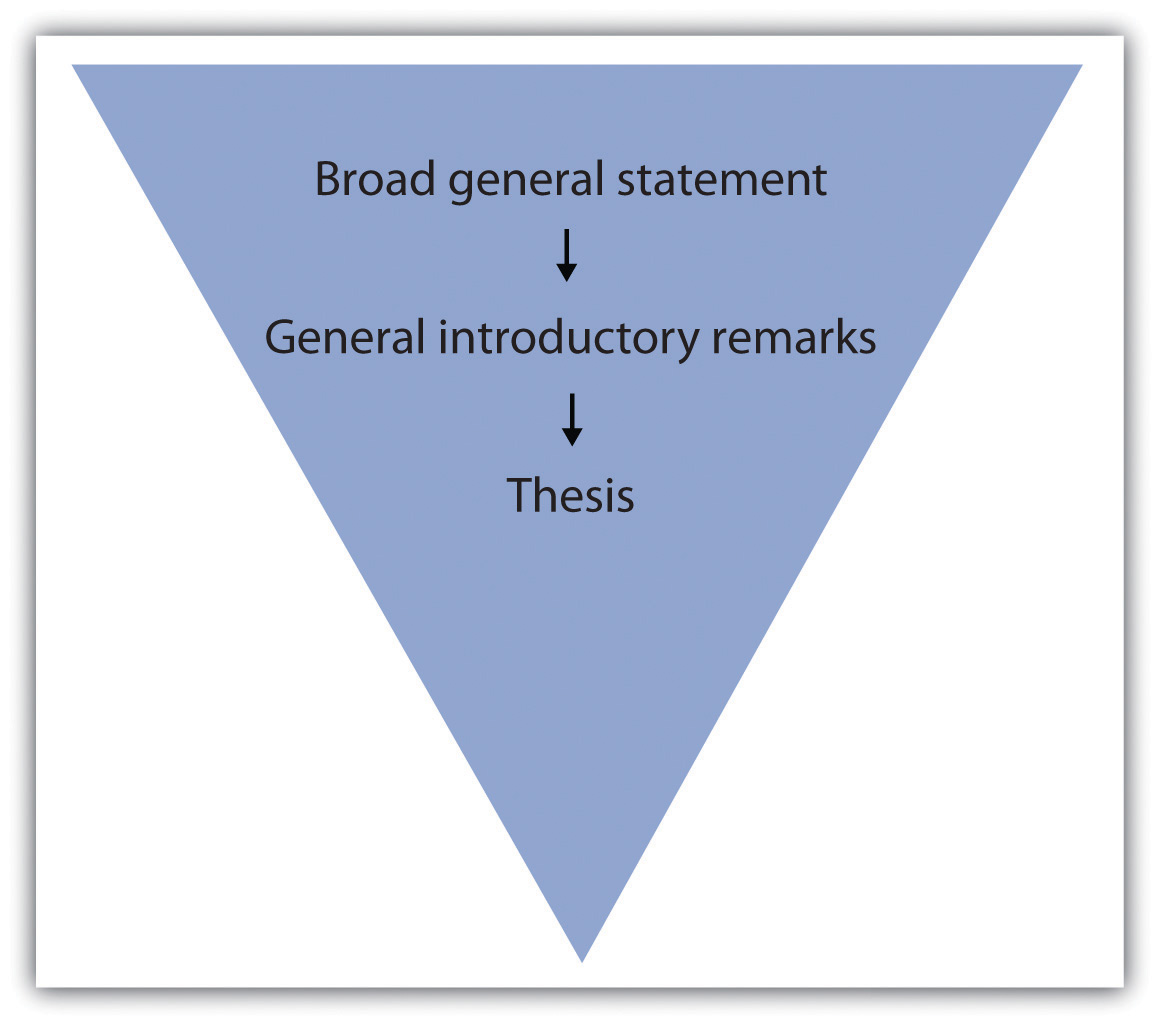
9.4 Writing Introductory and Concluding Paragraphs – Writing for Success


Body:

The body of your research paper is where the bulk of your work will go, however, you’ve already done most of the work! This is where your outline will come into play. All you will need to do is:

  • Expand each bullet point into full paragraphs. This should be as simple as turning any thoughts your wrote into complete sentences and paragraph form. Remember, any time you reference one of your sources, you must use the appropriate in text citation!
  • Add transition statements into your paragraphs. Every time you are about to begin a new thought, include a transition phrase or sentence. This will greatly improve the flow of your paper, and make it easier to both read and understand for your readers.
  • Fill in information gaps when needed. Sometimes,  one you take your outline into full paragraph form, you may find that there may be some information missing. If this is the case, simply either find more information to fill in with, or, if you need to reorganize to fix this that may work as well.

once you have finished the body of your research paper, the hard part is over! All that’s left is to write a conclusion, and create your references or works cited page.

Writing a Conclusion:

Your conclusion paragraph should wrap all any unfinished points in your paper, and draw your paper into a finished point. Think of it like the gift wrap around a wrapped present, neatly tying everything together in a neat little bow. Make sure that you restate your thesis in the conclusion as well. One thing to be wary of is that conclusion paragraphs should NEVER introduce new information!

Creating a Works Cited, References, or Bibliography page.

Once you have finished the rest of your paper, the final step is to create a references, or works cited page. If your paper uses MLA formatting, this will be a Works Cited page. If your paper uses APA formatting, this will be a References page. If your paper uses Chicago formattting, this will be a Bibliography Page. For more information on each, follow these links:

MLA

APA

Chicago

Always remember that whichever formatting you are using, your Works Cited, References, or Bibliography page should always be on it’s own page!

Once you tackle that, you have officially completed the draft of your research paper! At this stage, you would want to revise, edit, and peer review your paper. This is one of the many stages that the Writing Center would be a great help to you! As always, feel free to walk in, or make an appointment in person at the Writing Center, asynchronously online through our email, or online through Zoom!


Happy Writing!

~Cameron


Writing a Research Paper – Creating Citations

Now it’s time to cite your sources (so dreadful). BUT, when you know what information you’re looking for to cite and in what order, it really doesn’t have to be as terrible as it seems. Here is the Writing Center’s guide to MLA and APA citations 🙂

MLA in-text citations:

(Author’s name, page number)

(Author’s name) *IF YOU SAID THE PAGE NUMBER IN THE QUOTE.

(Page number) *IF YOU SAID THE AUTHOR IN THE QUOTE.

APA in-text citations:

(Author’s name, date)

(Author’s name) *IF YOU SAID THE DATE IN THE QUOTE.

(Date) *IF YOU SAID THE AUTHOR IN THE QUOTE.

MLA works cited page:

Books:

Last Name, First Name. Title of Book. City of Publication, Publisher, Publication Date.

Periodicals: 

Author(s). “Title of Article.” Title of Journal, Volume, Issue, Year, pages.

Websites:

Author(s). “Title of Webpage.” Title of Website, Publisher, Publication Date, URL or DOI.

APA works cited page:

Books: 

Last Name, Initial. (Publication Date). Title of book. Publisher.

Periodicals:

Last Name, Initial. (Publication Date). Title of article. Title of Journal, volume number(issue number), pages.

Websites:

Last Name, Initials. (Year, Month Date) Title of webpage. Site name. URL

~

Also, I use EasyBib as a great citation source generator. It’s just very important, because EasyBib isn’t always 100% accurate, that you can locate all the necessary information you need in your citation.

Happy citing!!!

~ Lauren

https://www.easybib.com/ 


Writing a Resarch Paper – Drafting an Outline

Hi Everyone!

Once you have chosen a topic, gathered information, and written a thesis statement, the next step towards completing a research paper is typically drafting an outline! Outlines are very beneficial to writing and they make the process of drafting your final paper a lot easier. Some additional benefits to creating an outline include:

  • Helping you keep your ideas organized
  • Presenting your idea in a logical order
  • Showing the relationships between concepts in your writing

So, how do you go about creating an outline? First, you want to determine the purpose of your paper. Next, consider who is the audience you are writing for? And finally, developing your thesis, which you should hopefully have already done! Then,

  • List out all of the ideas that you want to include in your paper
  • Take those ideas and organize any related ideas together
  • Put those groups of ideas into an order. Ususally, you want to work from more general larger ideas, to more specific points.
  • If needed for formatting, create headings and subheadings.

Keep in mind, creating an outline before writing your paper will make organization a lot easier. Weather you follow the guidelines listed above exactly, or modify it however may work for you, it will be beneficial to your writing process. Also, it will make drafting your paper in general much, much easier!

Happy outline writing!

~Cameron

Writing a Research Paper – Making a Thesis Statement

A thesis should be a very well put-together, effective, and demonstrative line in your research paper. It needs special attention because of how much it can set the tone for your work. However, when was the last time you were taught how to write a solid thesis? Have you spent any time in college working on how to write a collegiate-acceptable thesis?

No?

So, how about I offer up some guidance!

Your thesis should focus on your research, so ask yourself this:

  • What are you researching?
  • Why did you research it?
    • Are you trying to persuade your audience with an opinion backed-up with research? Are you trying to inform your audience about what you know that they don’t?

After you decide your answer to those questions, begin to generate some solid points to base your thesis around, and consider these questions:

  • Generally, what is your research essay going to cover?
  • What is the goal of your paper?

After you decide your answers for THOSE questions, try to toy around with what your thesis could be. It helps if you plan out a few ideas, almost as if you’re working with a rough draft, and then tweak all your ideas to make one awesome one. I’ll map this out using an example of me following my process above:

  1. I am writing a research paper about the impact of technology on students in the classroom.
  2. My research focuses on the facts surrounding the negative effects of technology on students, and I am also taking a look at sources that back up the adverse impacts of those negative effects on students and their quality of learning.
  3. I am researching this to inform my audience about how dangerous too much technology can be to young minds who are trying to learn new things and how teachers can combat it.
  4. My research essay is going to cover the statistics surrounding technology use with children, how it shows up in the classroom negatively, and how teachers can help students learn around the age of constant technology use.
  5. The goal of my paper is for my audience to become aware of how much technology can impact student learning, and I want them to become familiar with ways that teachers can help their students.
  6. Here are some thesis ideas:
    1. Children spend an excessive amount of time using technology, and because of this, they are experiencing adverse impacts on their quality of education.
    2. Teachers’ lack of resources to help students’ education is alarming, and there is research necessary to support the negative impacts that technology is having on students in this day and age.
    3. Attention needs to be spent on how to cure the age of addiction to technology in students, young and old, and this can be done with researched practices to support educators responsible for teaching this generation of students.

Some of my ideas take on a more persuasive approach to my paper. Since I want to inform my audience, I want to stay away from thesis #2. It has its strengths, but I use opinionated language like “alarming” that insinuates I am making a claim that I want my audience to support. Of my other theses, I like how straightforward thesis #1 is, but I also don’t hear my voice in my writing. I like how I can hear my passion in thesis #3, while also sticking to facts that I want to inform my audience on. So in this example, I would choose thesis #3.

Overall, writing a thesis is challenging because it’s like a recipe of ideas that need to be just right to articulate your paper perfectly in one sentence. If you’re someone who struggles with writing a thesis or can’t find the right words to use, try mapping your process out and being more intentional about where your ideas for your thesis are coming from.

AND, the Writing Center is always a great resource to get some advice or draft a thesis statement!

~ Lauren


Writing a Research Paper – Choosing a Topic

Choosing a topic is typically one of the first things you need to do when writing a research paper. It can also be one of the most difficult decisions to make regarding a research paper. Here are a few helpful tips to help with choosing a topic!

Typically, a professor will have you working within a specific guideline for a paper that may limit your realm of freedom when choosing a topic, but there are still a few things you can keep in mind:

  • Choose a subject that aligns with the Reasearch Paper Requirements
    • As mentioned above, Professor’s generally give guidelines that limit your realm of freedom when it comes to choosing a topic
    • Make sure that the topic you choose falls within the requirements of your Research Paper
  • Choose a subject that sparks personal interest
    • Choosing a subject that aligns with your personal interests will make the process far more enjoyable!
    • This may be difficult depend on what class it is for, but try to choose a topic that at least somewhat interesting to you.
  • Choose a topic that is focused enough that it is manageable
    • You don’t want to be so vauge in your topic that it is hard to find information that is specific to what you want to research

Good luck selecting a topic for your research paper that is intersting to you, fits the requirements of your assignment, and is specific enough to research. As always, feel free to stop by the Writing Center if you need help at any point in the writing process! Also, stay tuned for more blog posts helping to guide you through the steps of writing a research paper! 🙂


~Cameron